Wednesday, July 06, 2011

The Tiger’s Wife

Tea Obreht


Tea Obreht is the Orange Prize winner this year and is 26 years old. What can you say to such precociousness?

Yugoslavia and the Non-Aligned Movement; Tito and Nehru; these were so much a part of my growing up years. And then of course, the break up happened and we watched it with the growing realization that we were probably wrong all along. That ethnic identity that comes along with myriad languages and religions will always triumph over a manufactured secular one. It made us look inward at our own manufactured one and wonder and question.

And then twenty years after that civil war comes a book that uses as its setting, this strangely familiar Balkan land. It’s a tale, or rather, many tales, that can come only from old cultures with a rich storytelling history. It can seem exotic and elaborate and fantastic to many (as many reviews testify). But for someone who comes from the land of O.V.Vijayan’s Khazak, they sound eerily familiar.

Nathalie is a doctor of indeterminate nationality in the Balkans and her tale is of her grandfather’s – another doctor who grows up in the Yugoslavia of Tito and war-ridden Europe. So here are Nathalie and her grandfather, people of science, negotiating wartime conflicts with family and cultures brimming with myths that science has no answers for. There is the deathless man who Nathalie’s grandfather encounters over and over again, never-changing, never-dying, ready to lead the real dying to the next world. The grandfather refuses to believe him and his stories but even his rational scientific mind can't help but believe.

The tiger’s wife is a deaf-mute Muslim girl who befriends a wandering tiger, let out of a zoo by wartime bombing. And in the process, she incurs the wrath of a superstitious, scared village and a butcher of a husband. Nathalie’s grandfather is a little boy who is fascinated by the tiger and the girl’s friendship with him. And it leaves a lifetime impression and fascination with the animal, long after the girl is dead and the tiger moves away.

There are interesting side stories. That of Luka the butcher, a butcher by profession and a butcher to his young deaf-mute wife. There is Darisa the bear, a hunter with a passion for taxidermy, finally encountering a hunt he cannot win.

And there is Nathalie herself, who while dispensing rational medicine to villages in need, buys into the myths of the villagers without necessarily being consumed by them.

The narrative moves back and forth across time and characters and can prove disorienting at times. But it’s a classic storyteller’s tale and Tea Obreht proves a worthy Sheherzade.

And in the process of the telling these fables, we catch glimpses into the monstrosity of war and conflict that tear neighbours apart. “..the pieces that made up our country no longer carried the same characteristics that had formerly represented their respective parts of the whole. Previously shared things – landmarks, writers, scientists, histories – had to be doled out according to their new owners. That Nobel Prize winner was no longer ours, but theirs; we named our airport after our crazy inventor, who was no longer a communal figure….All his life, he had been part of the whole – not just part of it, but made up of it. He had not been born here, educated there. His name spoke of one place, his accent of another.” – The tragedy that is Yugoslavia is brought intensely alive without making too big a deal of it.

It’s a lovely little book, made all the more poignant with the nostalgia that comes with it. Tea Obreht is the latest in a long line of fabulists that start from the Mahabharat, runs through O.V.Vijayan, Marquez, Rushdie and Mitchell. A find.

Friday, July 01, 2011

To 'e' or not to 'e'

I am conflicted about my kindle. I use it a lot these days but I don't truly feel good about it, except in a very superficial 'I am with it' kind of way. I love underlining and scribbling on the corners of my books. I know I can make notes on the kindle too, but it is not quite the same as seeing my handwriting on the page. Plus, I love the way books clutter up my home. It gives it personality and bookshelves make great decor pieces. And long term, I hate to think my favourite landmark bookstore will one day disappear to be replaced by faceless online ones.
And then here is a different kind of conflict. Amitav Ghosh's new book is out. But it wasn't as yet in my bookstore last week. I saw it on flipkart and now I'm in a moral bind. Should I take away my business from my favourite bookstore and give it to that new-fangled online one? Truly, to 'e' or not to. That is the question.

Lightening Up

Here is a half-year resolution. To broaden things on this blog. To talk a bit more about life and a little less about books - though not talking books for me is kind of not talking life. To post opinion pieces more. To be less serious. To bring a bit more of real small talk. And be more visual. Hopefully it will bring me back to the writing more often. And you back to the blog as well. So here’s to a fresh new start.

Thursday, May 12, 2011


Freedom

By Jonathan Franzen

I have come late to this one (maybe that's my specialty - I always come late to much hyped authors and books, so I have no need to drown the hype out). It's a biggie. It put Franzen on the cover of Time magazine and got the book and the author finally on the Oprah show. It's a big All-American novel, transmuting America's politics into intimate personal portraits, Republican conservative vs Democrat liberal, the Iraq war and the ordinary American's complicity in it, environment politics. But better still, it is a biggie for me personally. I fall in love with it and its flawed characters.

It is a story of the Berglunds, Walter and Patty. And their children Joey and Jessica. And their parents, Ray and Joyce, Gene and Dorothy. And the third leg in their relationship, Richard, the aging rock musician, Walter's best friend and Patty's girlhood crush who turns into a mid-life affair. Walter and Patty are the typical baby boomers, Walter, the 3M executive and Patty, the college basketball star who turns discontented housewife and mother. Walter is a good man, fulfilling his responsibilities as a good son, loving husband and father. His inner rage and frustration at his dysfunctional parents and brothers are kept firmly in check and is a challenge to Patty, the love of his life, who is unable to do the same. She alienates herself from her family, parents who hush up the date rape she experiences, a mother who does not come to her basketball games she plays so well. She is a jock in a family of East Coast intellectuals and ends up building a suburban housewifey life that is at odds with all that her family holds in high regard.

It's a story that spans three decades of American history. It captures college life in the late seventies, solid middle class America in the eighties and the nineties and the slow creeping moral turpitude of a war mongering America in the next decade.

The politics move into the storyline imperceptibly. Joey is the rebel republican in a family of liberals. He gets involved in supplying faulty equipment parts to the army in Iraq, embroiling himself in the corruption that is the war. Walter meanwhile ends up tainting his moral soul heading a wild life conservation trust built on money made through dubious mining practices. He does it because it gives him the money and freedom to advocate population control, a cause dear to his heart. He further taints himself by falling in love with his assistant, bright, confident Lalitha, young enough to be his daughter. And with an already Richard-tainted Patty, it's a recipe for a collapsing marriage.

Each character is acting out personal roles to freedom in contemporary America. Yet each discovers in his or her own way, freedom is not quite enough. Love, relationships, moral ideals, ideas that possibly tie you down, restrict you, end up being more important. Life has a way of leading you to that discovery slowly but surely.

Patty is the heart of the novel. Her inchoate frustrations in trying to find herself through her roles as mother and wife, her secret desire for the bohemian life with Richard and her ultimate realization of how much Walter really means to her form, for me at least, the best part of the book. Her autobiographical diaries written in the third person at once seem unnecessary (there is so little difference between her tone and the author's) and absolutely critical.

It's a big sprawling book. It delves into each character with such depth and intensity, you are left with a feeling of having lived each of their lives. It is the story of one family, yet it gives the feeling that this is what contemporary America really is. It feels like one of those stories that can be the face of a nation's culture. What American Beauty did in cinema, Freedom seems to do in novel form.

Franzen's voice is not particularly interesting. But his tale certainly is. It's a book to be savoured, immersed in, talked about. It took nine years for him to write it. It has been worth the while.

Friday, April 22, 2011


The Accidental Tourist

By Anne Tyler

Anne Tyler is exquisite. I reached that conclusion after coming late in life to her arguably best novel - The Accidental Tourist.

Macon Leary is a travel writer who hates to travel. Out of his discomfort from leaving home comes a series of guidebooks called The Accidental Tourist aimed at making people feel as close to home as possible in cities around the world. Macon is strangely eccentric in his infuriating normality. He is a slave of habit, afraid of anything approaching spontaneity, dislikes the new and is quite obsessively repressed.

The book opens with Macon trying to save a crumbling marriage after the death of an only son. His wife Sarah moves out, unable to cope with Macon's stumbling obsessive efforts at maintaining normalcy in a completely abnormal situation, accusing him of a lack of engagement with the world.

As Macon lurches back into the Leary home with his two brothers and a sister, a household where he fits right in with his obsession for order and correctness, in comes Muriel, the dog trainer, into his life. Muriel in some respects is the exact opposite of Macon. She is a young single mother, trying to cope as well as she can with a life that is forever slipping out of control. Her jobs are ad hoc, her attempts at giving her son a normal life are forever being derailed and she has a set of friends and family who seem as chaotic as her. Muriel inserts herself forcefully into Macon's life, making him re-assess it in a way he never has before. "Some lived careful lives and some lived careless lives, and everything that happened could be explained by the difference between them." Macon is finally forced to choose between the carefully lived life and the carelessly lived one. And depending on your own inclination, the reader ends up feeling he was right or wrong. And that really is an indication of how powerful a writer Tyler proves to be.

Baltimore is the scene of this small scale domestic drama. And Tyler is a chronicler of the everyday, of quiet, gentle intrinsically good people, of characters who are infuriating yet endearing, conservative yet eccentric. Her relationships have no loud flourishes, just whimpering confusing moments of unexpected joy, disappointment, fear and loathing. It is Austen-esque in its scale and acuteness. And the question the book asks resonates with mid life in ways inexplicable. "Which was better? Take all you own, and struggle to carry it? Or travel light, and spend half your trip combing the shops for what you've left behind?"

Wednesday, February 23, 2011


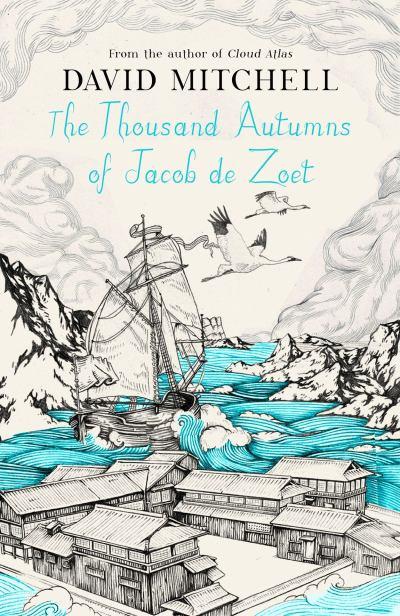
The Thousand Autumns of Jacob de Zoet

By David Mitchell

This is a long awaited novel. So long awaited that I bought the hard copy, not willing to wait for the paperback edition. Because Mitchell is an all time favourite. Ranks up there along with Murakami, Rushdie, Ghosh and Seth.

This is Japan in the late 18th century. A country so completely closed to the outside world that an outsider learns Japanese at the risk of being put to death. And then there is a tiny trading outpost called Dejima, outside Nagasaki. Where a handful of Dutch East India Company men are holed up. Dejima is the only small outlet of exchange between an increasingly colonised world and the Japanese kingdom. The Dutch have trading rights with closed Japan but are losing out to the other European powers - the British and the French, in the rest of the world.

Jacob De Zoet is a young Dutchman just come into Dejima. He is a Dutch bookkeeper out in the Orient to earn fame and fortune to win his beloved Anna back home. Brought in to clean up financial irregularities in the Dutch trading company, Jacob soon realizes there is little an honest clerk can do in the face of greed and temptation so far away from home.

It is an interesting cast of characters - a Dutch doctor dispensing Western medicinal knowledge to the Japanese in return for being allowed some exploration into a locked-to-the-world Japan; an ambitious Prussian clerk; Japanese interpreters curious about the Europeans and ready to profit from them too; slaves; labourers from Asia; Australian convicts; a hodge podge of people worthy of a Mitchell novel.

Jacob soon falls in love. With Orito Aibagawa, Japanese, beautiful, scarred, forbidden. She is a student of Dr. Marinus, allowed freedoms forbidden normally to women because she saved a magistrate's mistress's life and that of her son, during his birth. But the love is doomed. She is taken captive by a cult run by a monk wielding immense power in the capital. The triangle of Jacob, Aibagawa and her Japanese paramour who is also Jacob's translator is intense and quite heart-stoppingly tragic.

Parts of the novel read like a thriller. But there is no daring escape, no really happy ending for anybody. Evil is defeated but at a price. It is an autocratic cruel time that Mitchell describes. No one can really escape the tyranny of absolute power. Lowly bookkeepers, women, lowly translators, slaves... all are forced to submit to a class system somewhere. But world events do intervene to shape individual fates. A British warship in search of Japanese treasure attacks Dejima. Jacob's bravery in facing off this warship transforms his status. But he does not get the girl he loves. Nobody does. A magistrate's inevitable disgrace on not being prepared for the raid enables him to bring down an evil monk and his cult that had imprisoned Aibagawa. But he does lose his life in the process. And Aibagawa's hard-won freedom does not unite her with the man who loves her. It is a bit tragic and hopeful all at once.

This quaint historical setting is surprising if only for its rarity. Did you even know the Dutch were once in Japan? And why would this interest a globalised, digitised world today? Strangely enough it proves mesmerizing, with Mitchells' almost magical storytelling ability. He spins a very good yarn.

There is none of Mitchell's trademark gymnastics with point of view. He tells this story straight and with more than a little poetry. And makes you see the magic in the isolation, the enchantment in a Shangri-La-esque far corner of the world, a land of a thousand autumns. The Thousand Autumns of Jacob De Zoet is Mitchell at quite his best. And so I would say, that means it is one of the best stories you would ever read. Such is my faith in the man.

A Philosophy for Modern Life

  I read a book like this and I want to go back to school. The ideas, the people, the history! We often think of existentialism as something...