Monday, December 25, 2006


Small Town Ruminations

It’s not often that I travel beyond big cities in the country. So when work took me to Bareilly, I was quite looking forward to getting a deko at small town India. Bareilly is not really a small town – it has a population greater than 7 lakhs. Yet, in the hierarchy of Indian towns, it does get classified as a less than 10 lakh population town, so yes, it is a small town relatively speaking.

Of course, I had heard of Bareilly being the home town of Priyanka Chopra and had heard the song ‘bareilly ke bazaar mein, jhumka gira re’. Beyond that, I had difficulty recognizing that Bareilly and Rae Bareilly are 2 different places (I actually spent a whole lot of time planning my trip to Rae Bareilly, thinking they are one and the same). While this is an indicator of course of my dumbness, it is also a pointer to how insignificant any place beyond the big cities is, to the average metro dweller.

My drive from Lucknow to Bareilly was quite uneventful, despite several people warning me about travel (especially 2 women traveling without any male protection!) in UP during the UP elections. The sugarcane and mustard fields by the sides of the highway, the slow moving tractors on the roads that seemed to forever slow us down, the women with saree pallus covering their heads (completely incomprehensible to a south Indian), the mud huts with thatched roofs…all pointed to a stereotypical view of village north India.

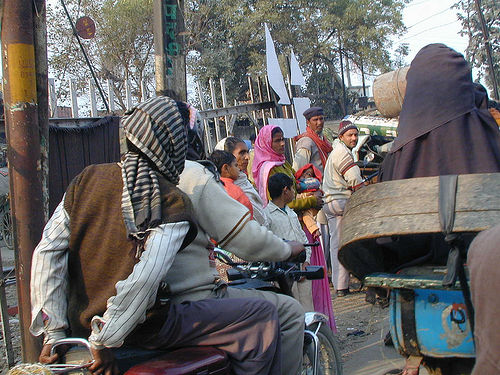
Bareilly town itself was a dusty, crowded affair. There was the obvious clock tower, the mosque, some semblance of colonial construction and the railway station. Beyond that, what registers is the rash of 2 wheelers, cycle rickshaws and auto rickshaws. The hotel we were taken to was supposedly the new plush one in town. There was little plushness in evidence – a cockroach in the bathroom and a possible one in the food put paid to any claims of luxury. Yet, it was serviceable. There was hot water and even a heater in the room. And the service staff was friendly.

A visit to the market place brought the whole small town feel right to the forefront. Coming on the heels of a film production, where we spent lakhs to re-create this bazaar feel in a set in Mumbai, this was ironic. The colours of the sarees hanging in the shops, the cacophony of sounds and smells, the women sitting on the cycle rickshaws, the absolute chaos of traffic where there was no way a car could get through those streets – it was the age old marketplace. Nothing might have changed in a century. The surma seller selling nothing else but kohl for the eyes was a revelation. We later learned, of course, that Bareilly is famous for the surma.

Yet there was evident change. ICICI, HDFC and SBI all had their ATMs here. We spoke to some young lower middle class girls (as part of ‘research’) and they were all dreaming big. There was no doubt in their minds that they were going to become a somebody in their lives. Bareilly was not the world for them. They want to move out – to Delhi and to other big cities. They want to become engineers, fashion designers and air hostesses. Marriage was a given, but that wasn’t stopping them from dreaming beyond it. And their mothers had the same dreams for their daughters. Where was the subjugated small town girl?

Bollywood and TV soaps ruled, of course. Hearts beat for Shahrukh, Salman and Hrithik, just as they beat for them in the big cities. Yet, going out to the cinemas was not all that common. The local theatre was showing the latest Hindi and Bhojpuri cinemas, but the girls were not watching their heroes there. They were watching them on VCDs at home – piracy rules! Kyunki was still going strong, but there were a rash of other replacements including the latest reality show – Big Boss. And advertisements were a window too to the world beyond.

Small town males though seem to have undergone little change. At a research group, the only males around were the guys from the local video recording unit. It was obvious that they had little clue on how to make a DVD player work with the TV. So when the female local recruiter suggested that they try plugging the cable into a different socket, the guy reacted so violently, it came as a minor shock. His expertise was being challenged by a woman and it was clear he didn’t like it one bit. But when it became obvious that the woman was right, the bully backed down and went away sulking. I guess the world around is changing too rapidly for a large section of Bareilly…and the reactions aren’t always going to be pretty.

When we took the road back to Delhi after two days in Bareilly, we were not unhappy to leave. Small towns at the end of the day are small towns. You can romanticize them to a certain extent, you can observe and make your research notes. You can note the fact that young women everywhere are the same – they squeal when they see a cockroach or a picture of a shirt-less Salman, they want to travel the world as an air hostess, they giggle when asked about boys. Yet, at the end of the day, you want to leave. You know there is nothing here for you. The big city lights beckon and you feel claustrophobic enough to do anything to catch the last flight home.
Wednesday, November 15, 2006


The Alchemy of Desire

By Tarun Tejpal

The book grabs you immediately with a dramatic opening line: “ Love is not the greatest glue between 2 people. Sex is.” The narrator (nameless throughout) you soon discover, is a young man in a marriage that is coming unglued slowly but surely. Desire, which has been a constant presence in their relationship, summoned up at will, any time anywhere, has suddenly and quite mysteriously disappeared. The narrator finds himself no longer desiring his wife Fizz (Fiza), a beautiful almost impossibly perfect woman. The novel takes us along their story at a brisk pace. A young couple, hopelessly in love, gets married, sets up house and with the husband’s ambitions of becoming a writer, struggle with holding down day jobs while allowing him to write at night. For this, they move from cozy Chandigarh to a harsher Delhi. With some money coming to them from his dead grandmother ( her story is one of my favourite parts of the book), they buy an old house in the Himachali hills. For a while, they enthusiastically do up the house, coming there every weekend from Delhi. While the husband struggles with writer’s block, their dream house is getting completed, a new roof is laid, bathrooms built and trees planted. That is when the buried diaries are discovered and their lives are irrevocably changed. The diaries detail out a parallel story, that of an American woman, Catherine, the original inhabitant of the house.

Catherine’s story is set in the late 19th century and veers from her American upbringing, her dad’s ‘exotic’ Indian store in New York, her flight to London and Paris to escape a marriage and her hedonistic life in Paris. It is in Paris that she meets an Indian prince who marries her and brings her to India. The Nawabi life, the strange relationship she shares with her homosexual husband and the palace intrigues that drive them into the hills to the house that Fizz and her husband buys in another century form her story. Catherine’s sexual appetite, her love affair with her husband’s lover and the strange turns this affair takes are detailed by her in her diaries. The diaries and her husband’s obsession with Catherine drive Fizz away. And the narrator is left to himself to play detective and uncover the mysteries that Catherine’s story contains. His discovery of the underlying truths unblocks his writer’s block and the end of the book sees him seeking Fiza out again and starting a book with the line, “Sex is not the greatest glue between 2 people. Love…”

Tejpal’s writing is bold and striking and he has an unabashed way of using drama in his words and phrases. The sex is prolific and after the initial excitement, it begins to pall. Catherine’s story especially has some pretty graphic descriptions of all kinds of couplings. Soon you begin to skip the sex parts and you realize that it is a lot of skipping. You then have to force yourself back into the story.

Overall, the book is interesting, purely because it tackles a refreshingly unusual theme – exploring the substance of desire. It goes just that bit over the top though – in language, in the depiction of an exotic 19th century India, in the sex. A bit more restraint might have made this a better book. But then again, it might have taken away some of its originality as well. My recommendation? Read it. There are worse books out there.

Monday, October 30, 2006

Lazy Poetry

Old woman sighs
In winter solitude;
A baby’s cry shatters it.

----------------------------

Rain falls ceaselessly
In its pitter patter.
The walls form a prison.

----------------------------

I wait.
The phone rings
And silences my thoughts.

----------------------------

Old age shivers
Middle age covers it with a shawl
The young look away bored.

----------------------------

Framed photographs and
Fresh flowers beside.
The decay smells.

----------------------------

Friday, October 27, 2006

#9 Dream

By David Mitchell

I don’t know what it is with the books I choose…Japan seems to be a big theme. #9 dream was the only David Mitchell I hadn’t read so far. And now that’s done too.

This was Mitchell’s 2nd novel – after the success of his debut novel Ghostwritten, he had huge expectations to fulfill. I loved the book. Better than his first, in fact. His cleverly constructed multiple narrative style in the first book gives way to a single story – that of Eiji Miyake and his Tokyo sojourn. Yet, he does manage to slot in different narratives even in this single story. A World War II diary of a kaizen pilot, Miyake’s sometimes Matrix-like dream sequences and a book of off-beat short stories Miyake comes across in a safe haven. There is a touch of Murakami in here (even the title is a Lennon song…Murakami’s Beatles mania at work?) and I will not be surprised if Mitchell admits to some influence here.

The lead character is Eiji Miyake, a 20 year old from an outlying Japanese village who comes to Tokyo in search of his father who he has never seen. His mother, who he despises, was his father’s mistress. Abandoned by his father when she bears him twins (Eiji and his twin sister Anju), she leaves her kids with her mother, takes to drink and becomes mentally unstable. The book is about Miyake’s discovery of Tokyo, the Japanese mafia, new friends and loves. And a re-discovery of who and what truly matters in life – not his disappointing father who never cared, but his mother who is too afraid to care, the memory of his dead twin and a new found love. It is Miyake’s journey into adulthood, into reconciliation with pain and disappointment.

Mitchell writes beautifully. His clever way with words and narratives can be quite intoxicating. He is currently my favourite writer and my newfound mission is to introduce him and his books to friends. A David Mitchell fan club is in order.

Friday, October 20, 2006


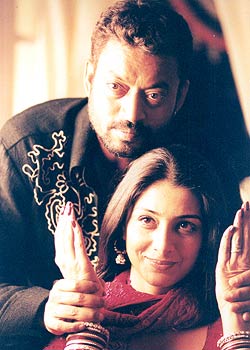
Maqbool


To be honest, I was disappointed with Maqbool. Maybe, coming into it from Omkaara, I had pretty high expectations from Vishal Bharadwaj.

The thing is, Maqbool lacks a hero. The closest anyone comes for me is Pankaj Kapoor as Abbaji. He is a powerful man who knows his power, inspires loyalty in at least some of his followers and is shown to have some principles when it comes to business (that his business is the Bombay underworld and what he refuses to do is smuggle arms into India for an ISI-like character is beside the point).

Irfan Khan or Mian Maqbool, the lead in the movie is to me a completely flawed character. While overweaning ambition is his fatal flaw, his susceptibility to Abbaji’s mistress Nimmi (played by Tabu in an excellent performance) and his complete paranoia after his crime of murdering his boss Abbaji make the viewer view him with something less than sympathy.

Shakespeare’s Macbeth is the basis for this Vishal Bharadwaj movie (he does have a knack of getting the settings right – the fight for the Scottish throne is transplanted to Mumbai’s underworld while later he would transplant Othello’s Venice to the heartland of UP). If you know of Macbeth, this movie resonates better. The 3 witches are superbly transplanted as 2 clairvoyant police officers in cahoots with the Abbaji gang – Naseer and Om Puri as usual are brilliant. Banquo’s ghost does not appear but Lady Macbeth’s famous speech of blood on her hands finds a parallel with Nimmi’s increasing loss of mental stability.

While individual pieces of the film are pretty brilliant, the overall effect is underwhelming. It is certainly less slick than Omkaara and lacks its star power as well. But that notwithstanding, the movie does stand out among the movies that get churned out of Bollywood.

Sunday, October 15, 2006

The number of apps for Flickr that abound are amazing. Here is a mosaic I created with my Flickr snaps.

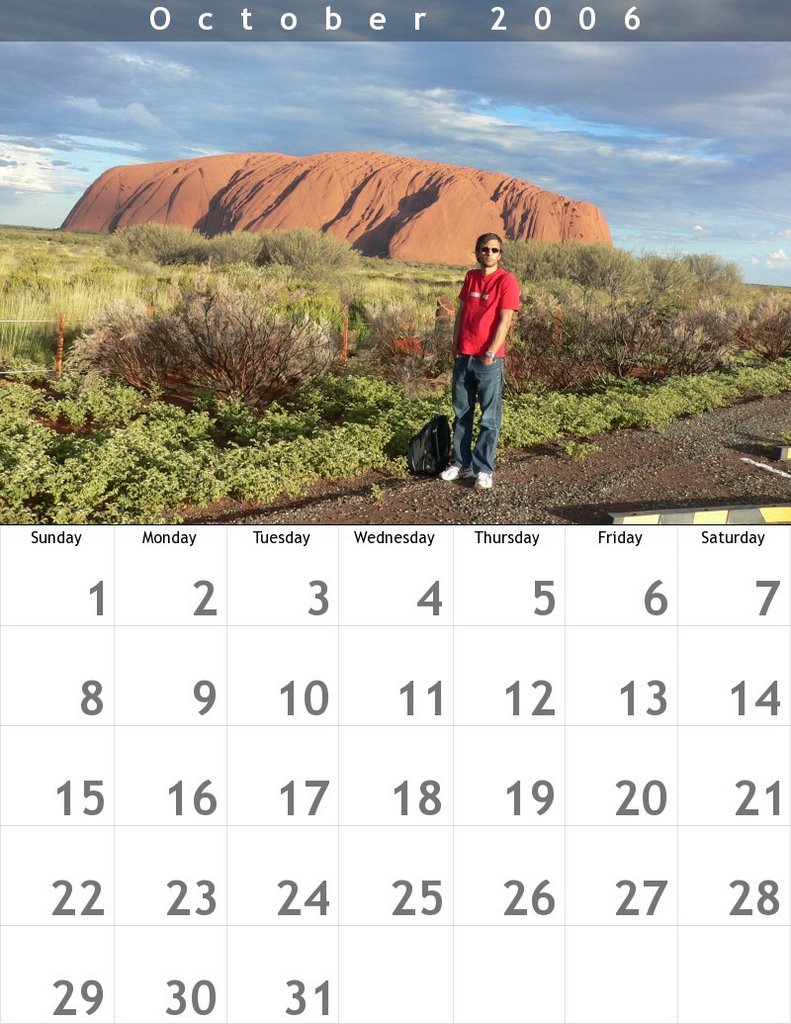
This is a calendar I created.
A fun movie poster I made with an old Uttaranchal trekking photograph (it was truly a physically exhausting trek!).

A watercolour framing of an old Taman Negara snap.

I feel like a kid with a toy with these tools. I love it.

Tuesday, October 03, 2006


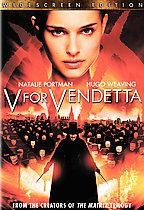
V for Vendetta

This is a ripping good movie – haven’t been entertained like this in quite a while. The Wachowski brothers tell a darn good story. They had a tough act to follow after Matrix, but they come good.

Of course, they have it in for Mr. Bush and that is pretty obvious. The England they portray, somewhere in the not-so-far future is a good estimate of what the US could be in 20 years time if the neo-conservatives had their way without any opposition. It’s an extreme portrayal, but if you can ignore the agenda, and just watch the movie as a movie, you can come away pretty satisfied with the experience.

The story is set in an England ruled by a Chancellor Sutler (John Hurt)who oversees a police state. He bans the Koran, torments gays and fosters a climate of fear. People who protest disappear overnight in camps that seem like Aushwitz but could as well be an approximation of Guantanamo Bay. V (Hugo Weaving whose face is never seen in the movie) is a Guy Fawkes mask-wearing former victim of the camp who is out to create a revolution. He spouts Shakespeare, leaves a rose as his signature in death scenes and is holed up in an underground Bat-cave-like hide-out filled with all things banned in the state outside. Evey (Natalie Portman) is the girl next door who is caught up in V’s grand plan – he starts off by blowing up the Old Bailey on Guy Fawkes day and announces his plan to blow up the Parliament buildings on the next 5th of November, inviting people who believe that they are living in a freedom-less world to join him. He has some pretty powerful lines – ‘a building is a symbol’ he says, when asked why he sets out to blow up buildings. After 9/11, that is a brave statement to make in a mainstream movie. I liked another line of his – ‘what is a revolution without dancing’, he says.

V gets the revolution he wanted – in a series of stylish, perfectly co-ordinated action sequences reminiscent of and yet distinct from Matrix. Leaving behind another classic line as a reminder to his by now vanquished foes – about how a man may die but the idea he represents will not. And a politically mature Evey to carry out his final grand plan.

I thought it was a brave movie made in an age of terrorism(one man's terrorist is another's freedom fighter, after all). It drew flak from a lot of people about the kind of messages it sends out (the original author of the graphic novel this book is based on, removed his names from the credits – his setting was Margaret Thatcher’s England) but as a pure entertainer, it is quite one of the best I have seen in a long while.

A Philosophy for Modern Life

  I read a book like this and I want to go back to school. The ideas, the people, the history! We often think of existentialism as something...